Time to pregnancy and sex of offspring: cohort study
BMJ 2005; 331 doi: https://doi.org/10.1136/bmj.331.7530.1437 (Published 15 December 2005) Cite this as: BMJ 2005;331:1437
- Luc J M Smits, lecturer (luc.smits{at}epid.unimaas.nl)1,
- Rob A de Bie, professor1,
- Gerard G Essed, professor2,
- Piet A van den Brandt, professor1
- 1 Maastricht University, Department of Epidemiology, PO Box 616, 6200 MD Maastricht, Netherlands
- 2 University Hospital Maastricht, Department of Obstetrics and Gynaecology, Maastricht
- Correspondence to: L J M Smits
- Accepted 5 September 2005
Introduction
The proportions of X and Y chromosome bearing sperms in human semen are equal, but more boys than girls are born. Male embryos and fetuses have a greater risk of attrition in utero than their female counterparts, and therefore male excess is likely to be still larger at the time of conception. It remains unexplained, however, what is responsible, presumably at some point between insemination and conception, for the greater probability of Y bearing sperms fusing with the ovum. One hypothesis relates to experiments showing that Y bearing sperms swim faster than X bearing sperms in viscous fluids.1 For natural conception, human sperms have to penetrate cervical mucus, the viscosity of which varies among and within women.2 Since mucal viscosity also influences the probability of conception,2 we expected that natural conceptions that take longer to achieve are more likely to be male than quick conceptions. We tested our prediction by assessing the relation between time to pregnancy and sex of the offspring.
Participants, methods, and results
We analysed data of 5283 Dutch women who gave birth to singletons between July 2001 and July 2003. All of the women, at about 14 weeks of pregnancy, were recruited by midwives and gynaecologists (response rate 5283/7200, 73.4%). Mean age of the women at the time of conception was 30.5 years; 83% of their pregnancies were planned, and 47% were delivering their first baby.
Among the 498 (9.4%) women with times to pregnancy longer than 12 months, the probability of male offspring was 57.6% (287), whereas the proportion of male births among the 4785 women with shorter times to pregnancy was 51.1% (2445, χ2 = 7.81, P = 0.0052). The proportion of male offspring after different times to pregnancy in the 4982 couples with natural conceptions is shown in the figure.
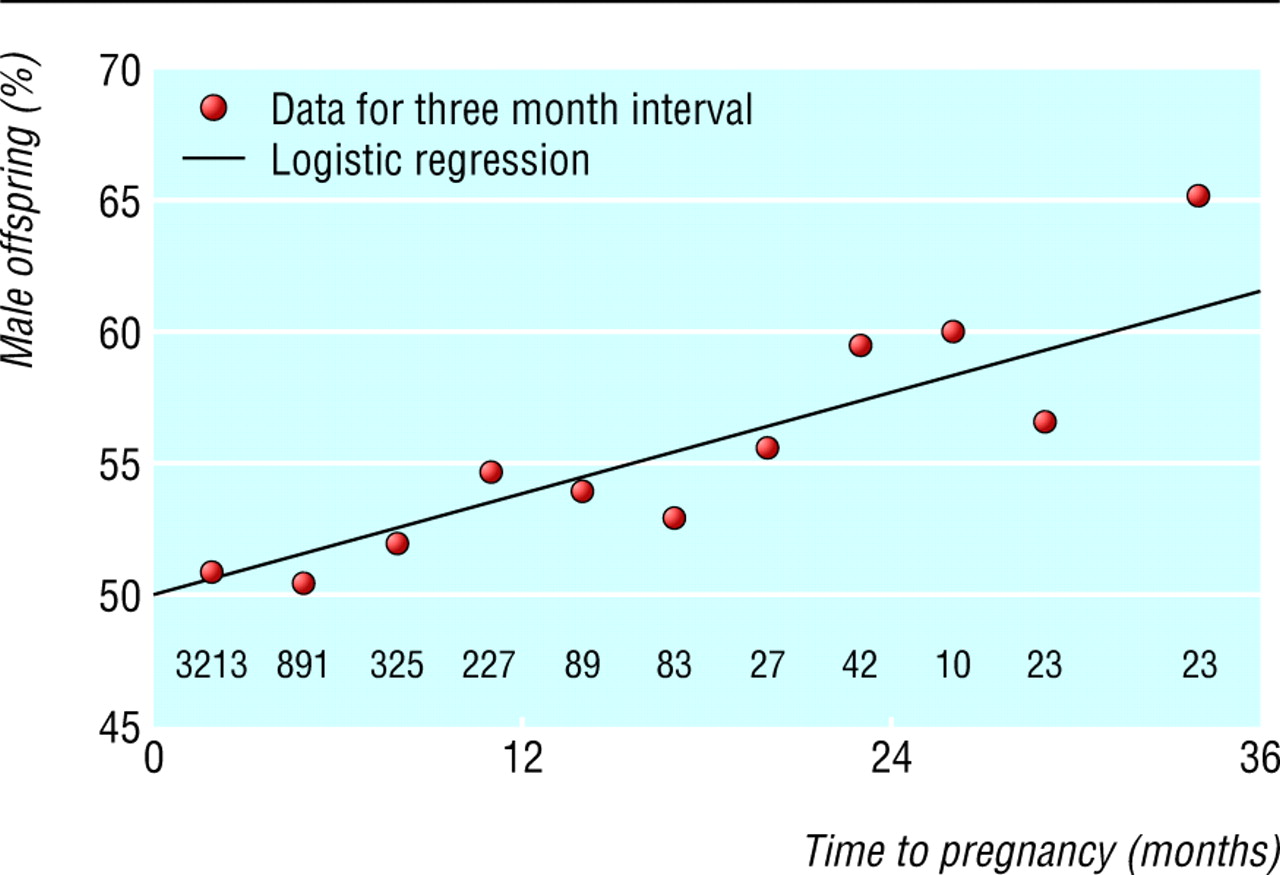
Percentage male births for three month categories of time to pregnancy for 4982 Dutch women with natural conceptions. Numbers are births from which percentages were calculated; times to pregnancy of 31-36 months were combined for paucity of observations; percentage male births for times >36 months 71% (n=26)

We modelled the relation between sex ratio (probability of male offspring divided by probability of female offspring) and time to pregnancy with logistic regression:
ln(sex ratio) = (0.0131 xtime to pregnancy)+0.0116 (P = 0.0020)
Using this function we computed that each additional year of trying to get pregnant is associated with a nearly 4% higher expected probability of delivering a male baby (see the line on the figure).
The association was robust to adjustment for maternal age, parity, body mass index, smoking status, alcohol use, season of conception, whether the pregnancy was planned or not, and variability of the menstrual cycle. Sex of the offspring of couples who had received medical help in getting pregnant (302) did not show any relation with time to pregnancy (β = 0.0030, P = 0.59).
Comment
The time taken to get pregnant is positively related to the chance of having a boy in couples conceiving naturally. The findings are consistent with the hypothesis that more viscous cervical mucus reduces the chance of conception and increases the chance of male offspring. Other explanations should nevertheless be considered. Firstly, while poor mucus quality may in itself be a cause of decreased fertility, it is often accompanied by hormonal problems and poor follicular development, conditions that may also give rise to lower birth rates by increasing the probability of early spontaneous abortion.3 Secondly, after multiple unsuccessful attempts at getting pregnant, couples may increase their coital rate and optimise the timing of their coital acts. Higher coital rates might increase the odds of male offspring; better timing, however, seems to have the opposite effect.4
What is already known on this topic
The proportions of X and Y chromosome bearing sperms in human semen are equal, and male embryos and fetuses have a higher risk of dying in utero than their female counterparts. Nevertheless, throughout the world, more boys than girls are born
Y bearing sperm may be able to swim faster than X bearing sperm through relatively viscous cervical mucus
What this study adds
Taking longer to reach lasting pregnancy increases the chances of having male offspring, consistent with the hypothesis that poorly penetrable cervical mucus causes lower fecundity and higher likelihood of male offspring
Previous work has considered a relation of offspring sex ratio with time to pregnancy.5 A slightly reduced sex ratio was found in infertile couples (time to pregnancy > 1 year). Comparison with the current findings, however, is complicated by the fact that no adjustments or subdivisions were made for assisted reproduction and the prevalence of reported infertility in the study population was unusually high (18%).
Footnotes
-
Contributors LS had the idea for the study, analysed the statistics, and wrote the final manuscript. RdeB wrote the study protocol and got the financial support. LS, RdeB, PvandenB, and GE developed the questionnaires, discussed the statistical analyses, and discussed and revised the manuscript. LS is guarantor.
-
Funding Dutch Health Council.
-
Competing interests None declared.
-
Ethical approval University Hospital Maastricht.