BMJ 2003;326:312-313 ( 8 February )

Papers

Cardiac troponin T in the severity assessment of patients with pulmonary embolism: cohort study

Karin Janata, consultantMichael Holzer, specialist registrarAnton N Laggner, professorMarcus Müllner, clinical epidemiologist

Universitätsklinik für Notfallmedizin, Allgemeines Krankenhaus Wien, Währinger Gürtel 18-20/6D, A-1090 Vienna, Austria

Correspondence to: M Mullner
marcus.muellner{at}univie.ac.at

Right ventricular function is an important prognostic factor for pulmonary embolism.1 Massive pulmonary embolism may lead to right ventricular failure, reduced left ventricular output, and even death.2 Cardiac troponins are routinely applied markers of minor and major myocardial damage in patients with acute coronary syndromes. In small case series, troponin concentrations were raised in patients with massive pulmonary embolism. 3 4 The role of troponin as a prognostic factor is, however, unclear. We assessed the association between serum concentrations of cardiac troponin T and severity of pulmonary embolism as well as the role of troponin T as a predictor of mortality.


    Participants, methods, and results
Top
Participants, methods, and...
Comment
References

We assessed 136 consecutive patients who were admitted to the emergency department of a tertiary care university hospital between December 1999 and November 2001 with pulmonary embolism, confirmed by computed tomography or scintigraphy. Two patients with terminal illness and seven patients admitted after cardiac arrest out of hospital were excluded. In 106 patients troponin concentrations were determined in the first 12 hours after admission (Elecsys 2010; Roche, Mannheim, Germany). The severity of the event was classified according to the grading system by Grosser (see table A on bmj.com).5 Right ventricular strain in the electrocardiogram was defined as right bundle branch block, T wave inversion in precordial leads, or S1Q3T3 pattern. We used Spearman's correlation and the Wilcoxon rank sum test and constructed a receiver operating characteristic curve based on sensitivities and specificities, using various troponin values as cut offs to determine mortality in hospital. We used routine data; studies using such data are not routinely reviewed by the local ethical review board.

The median age of patients was 60 (interquartile range 43-72) years; 74 (58%) were female. Six had fulminant pulmonary embolism, in 37 it was massive, in 62 it was submassive, and in one it was minor. With increasing severity of pulmonary embolism troponin concentrations also increased (r=0.56, P<0.001). The median troponin concentration in patients with signs of right ventricular strain in the electrocardiogram was 0.03 ng/ml (interquartile range <0.01 to 0.06) and in patients without these signs <0.01 ng/ml (<0.01 to <0.01, P<0.001). Ninety three patients underwent echocardiography, of whom 63 (68%) had signs of right ventricular strain1; the median troponin concentration in patients with signs of right ventricular strain was 0.03 ng/ml compared with <0.01 ng/ml (P<0.001) in patients without right ventricular strain.

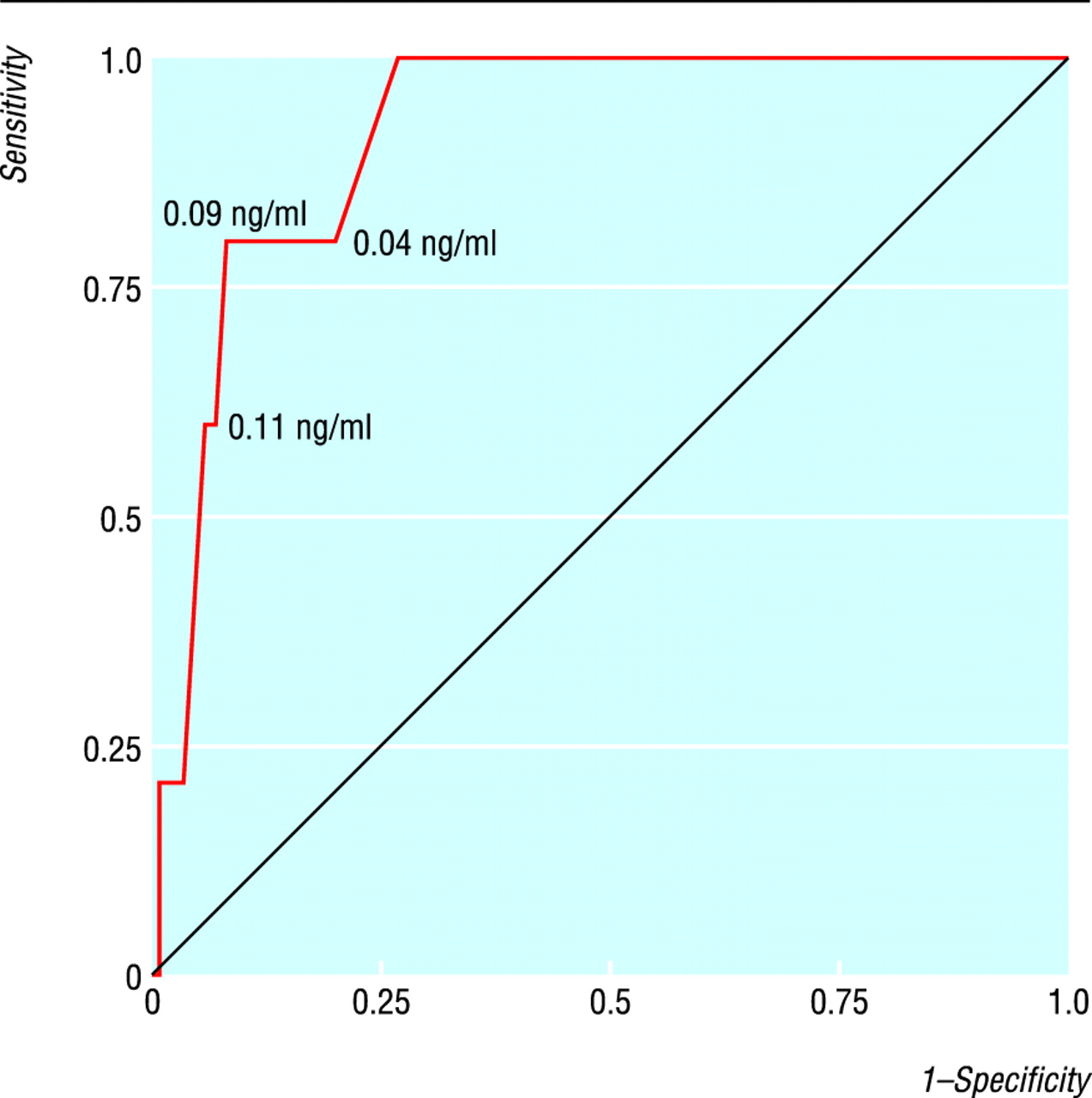
Five of 106 patients with troponin measurements died in hospital (5%); troponin concentrations were higher in patients who died than in survivors (0.18 ng/ml (0.09 to 0.18) v <0.01 ng/ml (<0.01 to 0.03), P<0.001). A cut-off value for troponin of 0.09 ng/ml was a suitable predictor for death in hospital (figure). The area under the curve was 0.92 (95% confidence interval 0.82 to 1.0), and the cut-off value had a sensitivity of 0.80 (0.49 to 1.0) and a specificity of 0.92 (0.87 to 0.97). The negative predictive value was 0.99 (0.93 to 1.00) and the positive predictive value 0.34 (0.10 to 0.59).


View larger version (29K):
[in this window]
[in a new window]
 
Receiver operating characteristic curve of cardiac troponin T and mortality. The values at the curve indicate the respective concentrations of cardiac troponin T


    Comment
Top
Participants, methods, and...
Comment
References

Raised concentrations of troponin T are associated with a higher in-hospital mortality in patients with pulmonary embolism. The major limitation of this study is that we do not know in how many patients pulmonary embolism remained undetected. We assume that missed cases had only minor symptoms and probably a good prognosis. Another limitation is that in 21 of the 127 eligible patients (17%) troponin was not measured. Patients with missing troponin values were younger (median 47 years v 60 years, P=0.014). The proportion of missing troponin values was similar in survivors and non-survivors (17%). Overall, we believe that this selection bias does not invalidate our conclusion. Whether troponin measurement can be used as a tool for clinical decision making---for example, deciding whether to give thrombolytic treatment---needs confirmation in larger prospective studies.

    Acknowledgments

Contributors: KJ collected the data for the pulmonary embolism registry, interpreted the data, and wrote the article. MH interpreted the data and wrote the article. ANL interpreted the data and critically revised the article. MM analysed and interpreted the data, wrote the article, and is, together with KJ, the guarantor for this paper.

    Footnotes

Funding: None.

Competing interests: MM works part time as an editor with the BMJ but had nothing to do with the peer review of this paper.

An extra table appears on bmj.com


    References
Top
Participants, methods, and...
Comment
References

1. Kasper W, Konstantinides S, Geibel A, Tiede N, Krause T, Just H. Prognostic significance of right ventricular afterload stress detected by echocardiography in patients with clinically suspected pulmonary embolism. Heart 1997; 77: 346-349[Abstract/Free Full Text].
2. Lualdi JC, Goldhaber SZ. Right ventricular dysfunction after acute pulmonary embolism: pathophysiologic factors, detection, and therapeutic implications. Am Heart J 1995; 130: 1276-1282[CrossRef][Web of Science][Medline].
3. Meyer T, Binder L, Hruska N, Luthe H, Buchwald AB. Cardiac troponin I elevation in acute pulmonary embolism is associated with right ventricular dysfunction. J Am Coll Cardiol 2000; 36: 1632-1636[Abstract/Free Full Text].
4. Giannitsis E, Muller-Bardorff M, Kurowski V, Weidtmann B, Wiegand U, Kampmann M, et al. Independent prognostic value of cardiac troponin T in patients with confirmed pulmonary embolism. Circulation 2000; 102: 211-217[Abstract/Free Full Text].
5. Grosser KD. Lungenembolie. Erkennung und differentialtherapeutische Probleme [Pulmonary embolism---problems in identifying and treating the condition]. Internist 1980; 21: 273-282[Medline].

(Accepted 15 August 2002)


© 2003 BMJ Publishing Group Ltd

Add to CiteULike CiteULike   Add to Complore Complore   Add to Connotea Connotea   Add to Del.icio.us Del.icio.us   Add to Digg Digg   Add to Reddit Reddit   Add to Technorati Technorati    What's this?

Relevant Article

Cardiac troponin T is raised in severe pulmonary embolism
BMJ 2003 326: 0. [Full Text]

This article has been cited by other articles:

  • Todd, J. L., Tapson, V. F. (2009). Thrombolytic Therapy for Acute Pulmonary Embolism: A Critical Appraisal. Chest 135: 1321-1329 [Abstract] [Full text]  
  • Authors/Task Force Members, , Torbicki, A., Perrier, A., Konstantinides, S., Agnelli, G., Galie, N., Pruszczyk, P., Bengel, F., Brady, A. J.B., Ferreira, D., Janssens, U., Klepetko, W., Mayer, E., Remy-Jardin, M., Bassand, J.-P., ESC Committee for Practice Guidelines (CPG), , Vahanian, A., Camm, J., De Caterina, R., Dean, V., Dickstein, K., Filippatos, G., Funck-Brentano, C., Hellemans, I., Kristensen, S. D., McGregor, K., Sechtem, U., Silber, S., Tendera, M., Widimsky, P., Zamorano, J. L., Document Reviewers, , Zamorano, J.-L., Andreotti, F., Ascherman, M., Athanassopoulos, G., De Sutter, J., Fitzmaurice, D., Forster, T., Heras, M., Jondeau, G., Kjeldsen, K., Knuuti, J., Lang, I., Lenzen, M., Lopez-Sendon, J., Nihoyannopoulos, P., Perez Isla, L., Schwehr, U., Torraca, L., Vachiery, J.-L. (2008). Guidelines on the diagnosis and management of acute pulmonary embolism: The Task Force for the Diagnosis and Management of Acute Pulmonary Embolism of the European Society of Cardiology (ESC). Eur Heart J 29: 2276-2315 [Full text]  
  • Jimenez, D., Diaz, G., Molina, J., Marti, D., Del Rey, J., Garcia-Rull, S., Escobar, C., Vidal, R., Sueiro, A., Yusen, R. D. (2008). Troponin I and risk stratification of patients with acute nonmassive pulmonary embolism. Eur Respir J 31: 847-853 [Abstract] [Full text]  
  • Begieneman, M P V, van de Goot, F R W, van der Bilt, I A C, Noordegraaf, A V., Spreeuwenberg, M D, Paulus, W J, van Hinsbergh, V W M, Visser, F C, Niessen, H W M (2008). Pulmonary embolism causes endomyocarditis in the human heart. Heart 94: 450-456 [Abstract] [Full text]  
  • Becattini, C., Vedovati, M. C., Agnelli, G. (2007). Prognostic Value of Troponins in Acute Pulmonary Embolism: A Meta-Analysis. Circulation 116: 427-433 [Abstract] [Full text]  
  • Renaud, B., Ngako, A. (2007). Heart-type fatty acid-binding proteins (H-FABP): a reliable tool for initial risk stratification of pulmonary embolism?. Eur Heart J 0: ehl433v1-2 [Full text]  
  • Giannitsis, E., Katus, H. A. (2005). Risk Stratification in Pulmonary Embolism Based on Biomarkers and Echocardiography. Circulation 112: 1520-1521 [Full text]  
  • Binder, L., Pieske, B., Olschewski, M., Geibel, A., Klostermann, B., Reiner, C., Konstantinides, S. (2005). N-Terminal Pro-Brain Natriuretic Peptide or Troponin Testing Followed by Echocardiography for Risk Stratification of Acute Pulmonary Embolism. Circulation 112: 1573-1579 [Abstract] [Full text]  
  • Piazza, G., Goldhaber, S. Z. (2005). The Acutely Decompensated Right Ventricle: Pathways for Diagnosis and Management. Chest 128: 1836-1852 [Abstract] [Full text]  
  • Macrea, M., Pruszczyk, P., Torbicki, A. (2004). Cardiac Troponin T Monitoring and Acute Pulmonary Embolism. Chest 126: 655-656 [Full text]  
  • Iles, S., Heron, C. J. L., Davies, G., Turner, J. G., Beckert, L. E. L. (2004). ECG Score Predicts Those With the Greatest Percentage of Perfusion Defects Due to Acute Pulmonary Thromboembolic Disease. Chest 125: 1651-1656 [Abstract] [Full text]  
  • Kucher, N., Goldhaber, S. Z. (2003). Cardiac Biomarkers for Risk Stratification of Patients With Acute Pulmonary Embolism. Circulation 108: 2191-2194 [Full text]  
  • (2003). British Thoracic Society guidelines for the management of suspected acute pulmonary embolism. Thorax 58: 470-483 [Full text]  
  • Bastin, A J (2003). Troponin T in pulmonary embolism. Thorax 58: 416-416 [Full text]  
  • (2003). Troponin T Predicts Pulmonary Embolism Severity. JWatch Emergency Med. 2003: 4-4 [Full text]  

Rapid Responses:

Read all Rapid Responses

Troponin-an "early window" for prognostication of massive PE,but urgent echocardiographt is a must
Ranjit Sinharay
bmj.com, 13 Feb 2003 [Full text]
There goes specificity!
Chris Chung
bmj.com, 14 Feb 2003 [Full text]
Elevated troponin in IE as well as PE
Richard W. Watkin, et al.
bmj.com, 18 Feb 2003 [Full text]
Severity scale in pulmonary embolism
José María Calvo-Romero
bmj.com, 21 Feb 2003 [Full text]
Pitfall of cardiac troponin in assessing PE severity
Parthipan Kantha Pillai, et al.
bmj.com, 21 Feb 2003 [Full text]
TROPONIN HAS A LONG WAY TO ESTABLISH ITSELF FOR THROMBOLYSIS IN PE.
Nandkishor V Athavale.
bmj.com, 21 Feb 2003 [Full text]
Authors' reply
Marcus Müllner
bmj.com, 8 Apr 2003 [Full text]


Doc2Doc Vacancy
Access jobs at BMJ Careers
Whats new online at Student 

BMJ